Auto FDT Address Adjustment in U-Boot
Auto FDT Address Adjustment in U-Boot
Problem
You may see this error in U-Boot when booting a kernel:
Did not find a cmdline Flattened Device Tree Could not find a valid device tree
Root cause: the kernel image ended up larger than expected and its end address overlaps (overwrites) the DTB already placed in memory. U-Boot loads kernel and FDT according to configured addresses (variables like fdt_addr_r). If the kernel’s end address grows and overlaps the FDT location, the kernel never sees a valid device tree.
Quick manual fix
Move the FDT address (fdt_addr_r) further up memory so it lives beyond the kernel end address and won’t be overwritten. That’s fine for one-off cases, but it’s manual and brittle when kernel sizes change.
Auto solution (what I implemented)
I created a general, boot-time auto-adjust mechanism that:
- Detects the actual kernel size / end address at boot.
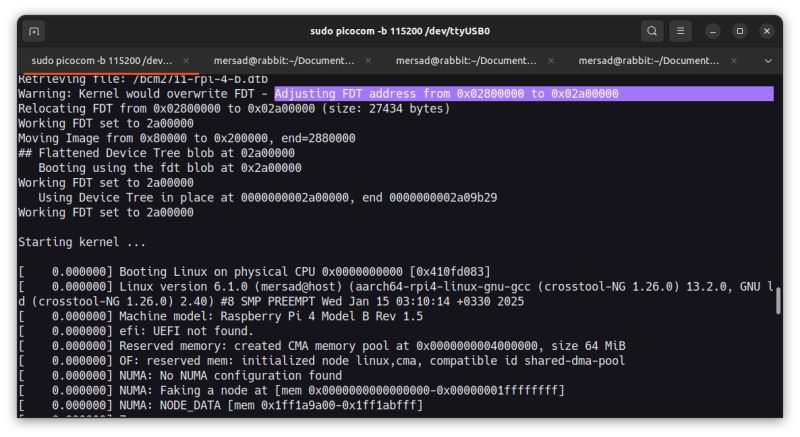
- If the configured FDT address would be overwritten by the kernel, computes a new safe FDT address (linearly offset based on kernel size) and updates
fdt_addr_rbefore the FDT is used. - Works for both interactive
bootcommand flows and automatedsysboot. - Is shipped as a bash script you place in the U-Boot root directory and enable (it’s enabled by default in my package).
- Targeted and tested for U-Boot v2023.10 (23.10). Might work on other versions but behavior/paths can vary.
How it behaves (conceptually)
- At boot (or when
boot/sysbootruns), U-Boot normally prepares kernel and FDT using configured addresses. - The auto-adjust logic calculates the kernel end address from the loaded kernel size.
- If
fdt_addr_r< kernel_end + padding, the script bumpsfdt_addr_rupward to a safe value (kernel_end + padding). - U-Boot proceeds with the adjusted FDT address; the FDT is no longer overwritten by the kernel.
Benefits
- No manual edits to device tree address variables after each kernel change.
- Works automatically for scripted and interactive boots.
- Prevents hard-to-debug boot failures caused by image-size growth.
Limitations & notes
- Default behavior in my package is enabled; you can disable if you prefer manual control.
- Make sure your chosen new FDT address does not collide with other memory usages (ramdisk, initrd, etc.). The script uses a simple padding policy; adjust if your board has special constraints.
- This is a runtime mitigation — best practice remains: choose stable, non-overlapping load addresses in your board config when possible.
- Tested on U-Boot 23.10; if you run a different U-Boot version, test carefully in QEMU or on a dev board.
Where to get it
- Script (bash): https://mega.nz/file/46tCmaAY#o57eQxyM_-iFh1MAGwsUMJW264ESE8LG8J2-yXlxuPI
- Documentation for the script: https://mega.nz/file/UjlUSLiS#tnx-g-EC0YlZp1s3e2JP034hNCtvINt37Pr99K4KKl0
This post is licensed under CC BY 4.0 by the author.