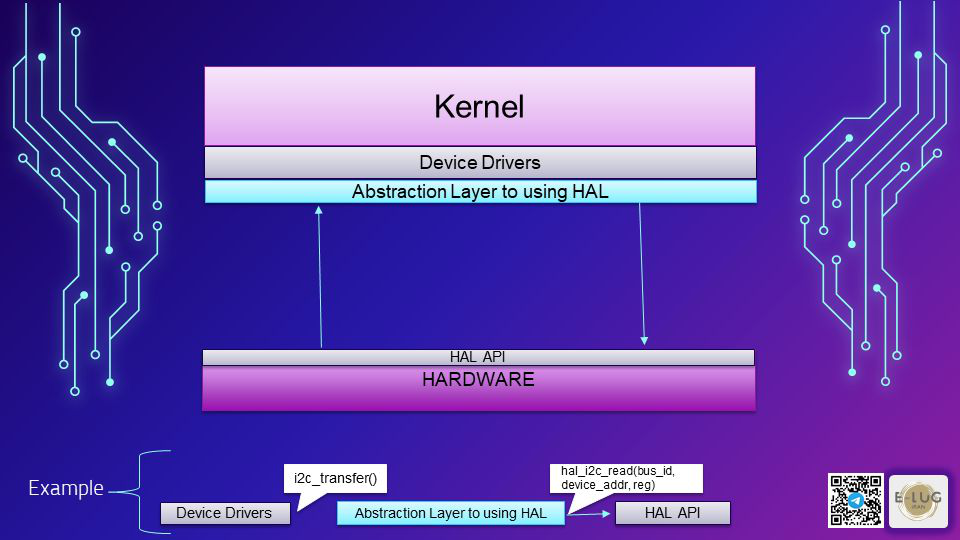
HAL and the Abstraction Layer for Register Access
As hardware vendors expose low-level functions to access device registers, we use those functions to port software to a board — for example to run Linux or FreeRTOS.
But drivers do not call vendor functions directly. Instead, there is a thin abstraction layer between drivers and the vendor HAL.
Short description
Vendors provide HAL primitives (register read/write, hal_i2c_write, SPI ops, clock/reset helpers). Driver authors use a small, generic API from the abstraction layer (e.g. i2c_transfer) and state what they want done. The abstraction layer maps that intent to the board-specific HAL call that actually touches registers.
How it feels for a driver writer
You don’t worry about vendor API names or register sequences — you call the generic API and handle results. The platform-specific mapping is handled elsewhere.
Simple request flow
- Driver: calls
i2c_transfer(request)— expresses intent (transfer data). - Abstraction layer: inspects board/hardware config and converts the request.
- HAL: executes
hal_i2c_write(...)(or equivalent) and performs register access. - Result flows back up to the driver.
Why this design
- Reuse: same driver runs on multiple boards by swapping HAL implementations.
- Isolation: hardware quirks and register details stay inside HAL.
- Easier porting and maintenance: change HAL to support new board; drivers remain unchanged.
Quick notes
- The abstraction layer is small but essential — it’s the glue between generic driver logic and vendor specifics.
- For complex buses (I²C, SPI, MMIO) the layer may include setup, timing adjustments, and error mapping.
- Keep driver code intent-focused and lightweight; push board-specific code into HAL.