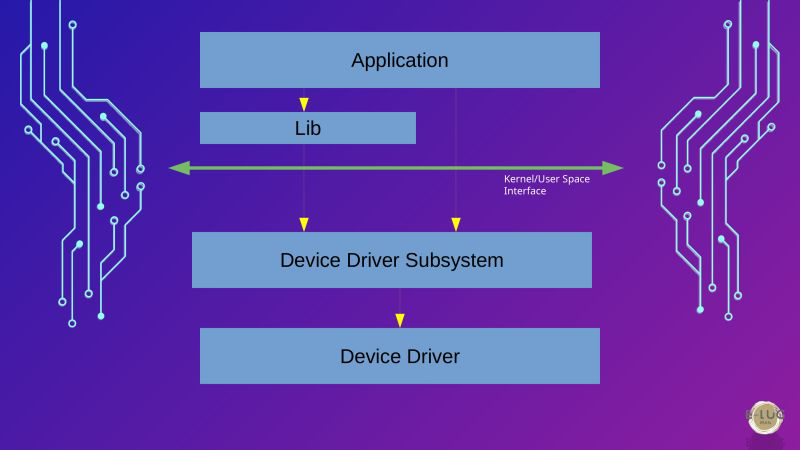
How Applications Talk to Drivers
Start with two simple questions an application developer and a driver developer often ask:
- As an application developer, do I need to know which exact device my browser will run on — a single device or every device?
- As a device driver developer, do I need to know which exact application will use my driver — one app or every app?
The short answer is no. Apps must interact with devices (for example, a browser needs a socket), but app authors should not and do not have to call device-specific functions directly. That job belongs to the driver. The glue between the two is the Driver Subsystem.
The idea in one line
Applications call standard APIs (e.g. socket()); drivers register their implementations behind generic hooks; the subsystem routes the app’s request to the correct driver implementation.
How it works (informal flow)
- The application calls a public API — for networking, something like
socket()from libc. - The call enters the kernel and reaches the Driver Subsystem, the layer that manages generic device APIs.
- The subsystem finds which driver should handle this request (e.g. the network driver for the active NIC).
- The subsystem calls the function the driver registered for that operation (a function pointer such as
my_netdev_opensocket). - The driver runs its code and performs the device-specific work (opening a socket, allocating buffers, talking to hardware registers). The result returns back through the subsystem to the app.
Function pointers — the essential trick
Drivers expose their capabilities via a table of function pointers. The code looks roughly like: dev->opensocket = &my_netdev_opensocket;
When the subsystem needs to open a socket for that device, it calls dev->opensocket(...) without knowing which concrete function that is. That indirection decouples app-facing APIs from vendor-specific implementations.
Why this matters
- Apps stay portable — same
socket()works across different hardware. - Drivers stay focused — they implement device behaviour and register it; they don’t embed app-specific logic.
- Portability & maintenance — to support a new board you only change the HAL/driver registration, not all apps.
Small practical notes
- Sometimes drivers and userspace are tightly coupled (printer drivers or dedicated user-space drivers); that’s a special case.
- The example above omits many kernel details (namespace lookup, device tables, locking, error mapping) — the goal is to show the overall pattern. For deeper reading, check materials on the Linux Device Model and driver ops tables.